Corporate Cash Management Strategies: How to Optimise Liquidity Across Multi-Entity Groups


For finance leaders at UK companies, executing effective cash flow management strategies is no longer just an operational routine, it is a capital preservation mandate. In a financial landscape shaped by volatile structural adjustments, high borrowing costs, and shifting market conditions, the gap between knowing your cash position and being able to deploy it dynamically is where corporate value is either eroded or unlocked.
When evaluating a cash management strategy CFOs, Group Treasurers, and Financial Controllers managing a turnover between £30m and £300m face a unique paradox: your operations are as complex as a FTSE 250 enterprise, but your internal treasury resources are often lean. Managing cash flow across multiple corporate legal entities, distinct bank networks, and various currencies requires moving away from manual accounting towards institutional treasury cash management.
This guide outlines advanced cash management strategies for business organizations designed to break down information silos, master cash management strategy liquidity, and leverage automated cash management solutions to protect your group’s margins and long-term financial stability.
Understanding Cash Management in Financial Management
To contextualise these frameworks, we must first look at the broader perspective of cash management in financial management. It is a comprehensive system of coordinated financial planning decisions that directly dictate whether an enterprise can scale safely.
What is the Cash Management Services Meaning for Enterprises?
In high-volume corporate ecosystems, decoding the modern cash management services meaning goes beyond basic transactional processing or looking for generic cash management in banking. It refers to the structured suite of technology infrastructure, liquidity facilities, and data pipes that a company uses to globalize its cash visibility, handle intercompany agreements, and deploy capital efficiently.
A high-performing cash management strategy company operating multiple subsidiaries must actively navigate three core operational frictions:
Fragmented Banking Ecosystems
Managing disparate accounts across various retail networks without a single, consolidated view of funds.
Trapped Cash & Intercompany Friction
Subsidiaries holding idle cash balances in one entity while sister companies draw down expensive lines of credit.
Multi-Currency Volatility
Managing aggregate cash needs across GBP, EUR, and USD without real-time, tech-driven FX exposure mapping.
1. Dynamic Liquidity: Transitioning to Tech-Driven Cash Flow Management Strategies
A fundamental pillar of any modern SME cash flow management strategy targeting the upper-mid market is moving away from static annual budgets toward automated cash forecasting.
Static annual budgets are poor cash management tools because they suffer from immediate data latency. Conversely, a 13-week rolling cash flow forecast bridges the gap by actively mapping live bank balances against operational cash cycles. The 13-week horizon has become the global standard for corporate cash management strategies precisely because it is operationally actionable: it provides enough foresight to spot systemic shortfalls while remaining granular enough to guide weekly capital management decisions.
Eliminating Common Cash Forecasting Pitfalls
The Spreadsheet Debt
Relying on macro-heavy Excel sheets that suffer from human error, broken formulas, and version-control failures.
Siloed Subsidiary Reports
Financial controllers emailing fragmented localized cash reports on Friday afternoons, causing massive friction during group consolidation.
Decoupled Ledgers
Accounts Receivable (AR) and Accounts Payable (AP) ledgers sitting isolated from the actual cash positioning tools.
Implementing a Cash Management System: |
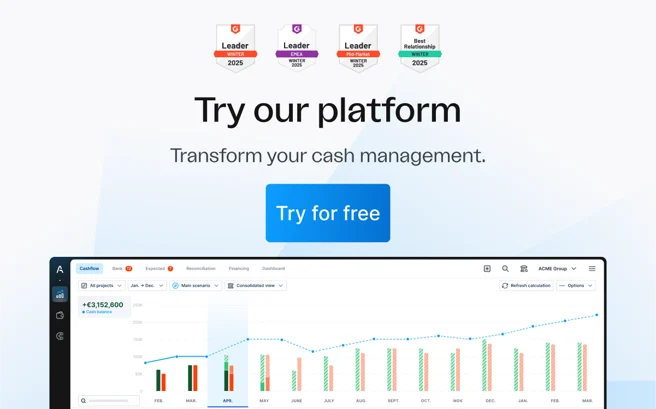
Modern, tech-driven cash flow management strategies resolve this by embedding direct API integrations with your entire UK and international banking stack. A dedicated cash management system like Agicap automatically aggregates transaction data, eliminates manual input errors, and categorizes cash inflows and cash outflows in real time, making rolling forecasts sustainable at scale.
2. Accelerating the Cash Conversion Cycle (Working Capital Best Practices)
Executing effective cash management at the operational level requires teams to aggressively compress the cash conversion cycle (CCC). Every single day corporate cash remains locked in inventory or unpaid invoices is a day it isn’t generating higher returns or paying down debt.
Strategies to Improve Cash Flow Management via Accounts Receivable
In the UK, B2B late payments remain a persistent drag on liquidity. While the Late Payment of Commercial Debts (Interest) Act 1998 provides legal recourse, proactive operational engineering is far more effective:
Automated Dunning Workflows
Implement system-driven, multi-channel payment reminders tailored to customer segments before the due date.
Real-Time AR Ledger Matching
Align your collection efforts directly with live bank feeds to stop collections activities the moment a payment clears.
Reviewing Key Treasury KPIs:
Tracking days sales outstanding (DSO) monthly to identify payment friction before it turns into a severe cash shortage.
Careful Planning of Payment Terms with Suppliers
On the payables side, the objective is to optimize days payables outstanding (DPO) without damaging critical supply chain relationships or breaking a commercial vendor agreement.
When evaluating a cash management strategy short term, treasury teams must weigh early payment discounts against their weighted average cost of capital (WACC). If a supplier offers a 1% discount for net-10 payment terms when central bank interest rates and borrowing costs are elevated, careful planning might reveal that it is more capital-efficient to retain that excess cash in a yield-generating corporate treasury account until net-30.
3. Achieving Centralised Multi-Entity Cash Visibility and Cash Pooling
For multi-entity companies, achieving absolute cash visibility is the single highest-ROI initiative a finance team can undertake. Without a centralized "cash map," group treasury cannot implement advanced cash management techniques like automated cash pooling or intercompany netting.
Feature / Capability | Legacy Spreadsheet Approach | Modern Cash Management Solution (Agicap) |
Data Collection | Manual CSV downloads, token logins per bank | Automated API & Open Banking aggregation |
Refresh Frequency | Weekly or bi-weekly | Real-time / Multiple times daily |
Intercompany View | Blind spots on inner-group transfers | Consolidated dashboard with entity-level filtering |
FX Exposure | Manual conversion calculations | Live multi-currency translation and monitoring |
Centralising all cash positions allows the corporate treasury function to instantly identify pockets of idle cash across different legal entities. Instead of letting cash sit unproductive earning zero interest, or forcing a subsidiary to execute an expensive draw on a bank line of credit, the group can orchestrate automated internal balancing to meet localized cash needs, reducing aggregate borrowing costs across the entire organization.
4. Structuring a Short-Term Corporate Liquidity Policy
An actionable cash management strategy requires clear corporate governance. A formalised liquidity policy defines strict operational boundaries for the finance team, ensuring the business holds sufficient liquidity to meet all operational expenses, tax liabilities, and unforeseen market shifts.
Tiered Cash Reserves Architecture
Tier 1 (Operational Capital)
Maintained in primary operating current accounts to clear immediate, high-velocity cash outflows (payroll, critical suppliers).
Tier 2 (Reserve Capital)
Held in instant-access high-yield savings accounts or institutional Money Market Funds (MMFs) to protect against unexpected operational shocks.
Tier 3 (Strategic Capital)
Deployed into short-term notice accounts, certificates of deposit (CDs), or short-dated UK Treasury Bills to capture yield on structural surplus cash without exposing funds to market risk.
A regular review cadence of these tiers ensures that the allocation shifts dynamically alongside changing macroeconomic metrics and corporate growth plans.
5. Proactive Debt and Covenant Management
Access to external financing facilities (such as Revolving Credit Facilities (RCFs), asset-backed lending, or invoice discounting) is an essential liquidity buffer. However, relying on these facilities blindly can jeopardize corporate stability.
Most UK mid-market debt facilities are bound by strict financial covenants (e.g., Leverage Ratios, Interest Coverage Ratios). A robust cash management infrastructure models these covenant thresholds directly into your rolling forecasts.
By stress-testing cash flows against macro scenarios (such as a 10% supply chain cost inflation or a 15-day extension in customer payment behaviors), CFOs can simulate covenant headroom and engage with their lenders months before a technical breach occurs. Banks respond far better to early warning of covenant pressure than to surprises.
6. Embracing Technology: Shifting from Spreadsheets to a Treasury Management System
The evolution of financial operations requires modern architecture. For a high-growth enterprise, spreadsheets are a structural risk, susceptible to human error, lack of audit trails, and data latency.
When assessing enterprise-grade cash management tools, CFOs should prioritise solutions designed to bridge the gap between operational accounting and high-level corporate treasury.
Core Tech Stack Requirements for 2026:
Plug-and-Play Bank Connectivity
Native support for UK Open Banking, SWIFT, and direct host-to-host bank protocols.
ERP and Billing Engine Agnosticism
Seamless data ingestion from systems like NetSuite, Sage Intacct, Microsoft Dynamics, or SAP.
Dynamic Scenario Modelling
The ability to simulate major strategic shifts (such as an M&A integration, international expansion, or capital expenditure programs) and immediately visualize their impact on group liquidity.
Agicap was built for companies with multi-entity management. By automating multi-entity data consolidation and combining it with intuitive, predictive forecasting tools, Agicap transforms the cash management function from a backward-looking administrative burden into a forward-looking, value-generating strategic asset.
Cash Management Strategies: Quick-Reference Summary
Strategy | Objective | Key Action | Tool / Method |
Cash flow forecasting | Predict future cash positions | Build rolling 13-week forecast | Treasury management system |
Working capital optimisation | Reduce cash conversion cycle | Tighten debtor days, extend creditor terms | AR automation, payment tracking |
Cash visibility & centralisation | Real-time view of all cash positions | Connect all bank accounts to single platform | Bank feed integration (e.g. Agicap) |
Short-term liquidity policy | Protect against cash shortage | Set minimum reserves, deploy idle cash | Money market funds, short-term deposits |
Banking & credit management | Ensure funding availability | Maintain RCF, monitor covenants | Bank relationship management |
Technology & automation | Scale processes, reduce error | Replace spreadsheets with dedicated software | Agicap, ERP integration |
Frequently Asked Questions (FAQs) about Cash Management Strategies
What are cash management strategies?

Cash management strategies are the structured corporate frameworks and processes an organization uses to monitor, balance, and optimize its cash inflows and cash outflows. These strategies span across cash forecasting, working capital optimization, banking relationships, liquidity policies, and the deployment of advanced software tools to maintain corporate financial stability.
What are the four elements of effective cash management?
The four core elements of effective cash management include:

Cash Forecasting:
Predicting future cash positions over short and medium-term horizons.
Cash Positioning:
Gaining real-time visibility over where funds sit across all bank accounts and legal entities.
Liquidity Management:
Establishing minimum cash reserves to cover operational expenses.
Cash Optimisation:
Putting idle cash or surplus cash to work to achieve higher returns while reducing overall borrowing costs.
What is an effective technique to improve cash management?
The single most impactful technique is transitioning from manual spreadsheets to an automated cash management solution that drives a 13-week rolling cash flow forecast. Combining real-time bank data with automated ERP tracking gives finance teams the exact visibility needed to take proactive action before a cash shortage materializes.
What are cash management solutions?
Cash management solutions are specialized software platforms designed to automate corporate treasury processes. These tools integrate directly with banking networks and ERP systems to consolidate data, track multi-currency cash flows, streamline multi-entity accounts receivable, and generate real-time forecasts, replacing manual accounting workflows.
Why is cash important to a business?
Cash is important because it represents the ultimate operational liquidity required to sustain daily business transactions. Unlike paper profits or revenue metrics, cash is the absolute medium used to settle immediate debts, clear legal obligations, and ensure the enterprise remains solvent under volatile market conditions.
Why is cash flow important to a business
Cash flow is critical because it measures the velocity and health of cash moving into and out of an organization. Even highly profitable companies can face sudden insolvency if they suffer from poor cash flow management, delayed collections, or mismatched payment terms with suppliers. Maintaining a positive cash flow ensures a company has the agility to invest in growth, fund R&A, and navigate economic downturns.
Take Strategic Control of Your Group Liquidity
Legacy cash tracking cannot keep pace with modern corporate complexity. If your finance team spends more time aggregating data from different banking portals and entity spreadsheets than analyzing strategic cash trajectories, your technology stack is holding your business back.
Agicap delivers real-time group-wide visibility, automated multi-currency rolling forecasts, and streamlined multi-entity consolidation for companies navigating the £30m to £300m growth curve.