Rolling Forecast for Your Business: A Complete Guide to Continuous Cash Flow Planning


Rolling forecast is a financial planning method that continuously updates cash flow projections by shifting the planning horizon forward, week by week or month by month. Unlike a static annual budget that gets locked in December and outdated by March, a rolling forecast always gives you a current view of the next 13 weeks or 12 months regardless of where you are in the fiscal year.
The fundamental problem with traditional forecasting is the wall. A static annual budget covers a fixed period ending at fiscal year-end. As months pass, the horizon shrinks. By Q3, your budget only sees three months ahead. By November, you’re essentially blind beyond the year-end cliff, with no structured view of what comes next. That’s the wall: a hard limit beyond which your organization has no forward visibility, no matter how well your model was built.
In this guide, Agicap explains what a rolling forecast is, how it compares to a traditional budget, how to implement it step by step in your organization, and what tools will help you run the process efficiently, whether you’re managing a single entity or a complex multi-entity corporate group.
What Is a Rolling Forecast? Definition and Core Mechanics
A rolling forecast is a financial projection that is updated on a regular cadence, typically weekly or monthly, by adding a new period to the end of the forecast horizon as the most recent period closes with actual data. The result is a forecast that always covers the same number of forward-looking weeks or months, no matter when you consult it.
The mechanics are straightforward: if you’re working with a 13-week horizon and Week 1 closes with real bank data, you add Week 14 to the forecast. The window rolls forward, maintaining the same depth of visibility. That’s where the name comes from the planning window advances continuously, like a moving frame.
Unlike an annual budget that relies on assumptions about a full fiscal year, a rolling forecast builds on concrete data: issued invoices with known due dates, committed payables, payroll, scheduled debt service, and tax obligations. Accuracy is high in the near term and becomes increasingly estimate-based as you move further into the horizon.
Rolling Forecast vs. Traditional Budget: Key Differences
The difference between a rolling forecast and a traditional budget goes beyond update frequency. It reflects a fundamentally different approach to financial management.
Criteria | Traditional Budget / Forecast | Rolling Forecast |
Update frequency | Once a year (or quarter) | Continuous: weekly or monthly |
Time horizon | Fixed: end of fiscal year | Fixed in length: always 13 weeks or 12 months |
Data basis | Assumptions made at period start | Actual data + updated assumptions |
Reaction to change | Ad hoc revision | Built into the regular process |
Operational utility | Annual strategic planning | Real-time decision-making |
Operational burden | High at start, low after | Distributed consistently |
The 13-Week Horizon: Treasury vs. FP&A Planning
In US finance teams, there is an important distinction between FP&A and treasury planning.
FP&A owns the long-range plan and the annual budget, typically a 12-to-18-month view built on strategic assumptions. Treasury’s job is different: it manages the actual cash position in the near term and ensures the business never runs out of liquidity.
The 13-week rolling forecast sits squarely in the treasury's domain. Three months is the window in which most payment commitments are already identified and expected collections are reasonably predictable. Beyond 13 weeks, uncertainty grows and operational precision declines. Within that window, the forecast is grounded in concrete data (real invoices, committed payables, scheduled payroll), not strategic assumptions.
Horizon | Data Type | Accuracy | Primary Use |
1–4 weeks | Invoices, committed payments | Very high | Daily cash operations |
5–13 weeks | Forecasts with confirmed data | High | Anticipating liquidity gaps |
13–26 weeks | Estimates with assumptions | Medium | Financing planning |
12 months | Strategic assumptions | Low–medium | Strategic budget / FP&A |
A traditional annual budget still has its place: it’s useful for setting annual targets, communicating with investors, and planning long-term commitments. But as an operational treasury management solution, it falls short the moment reality diverges from the plan which, at mid-market companies, happens regularly. A rolling forecast doesn’t replace the annual budget; it layers continuous visibility on top of it, enabling you to act before problems become urgent.
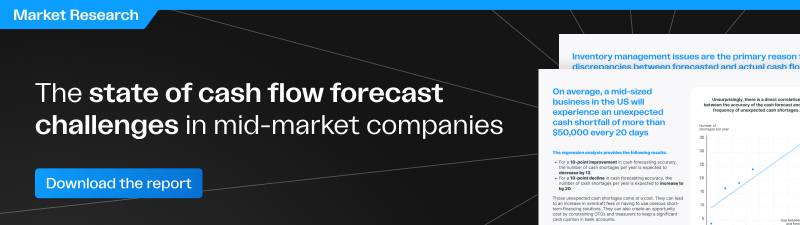
According to Agicap research on treasury challenges at mid-market companies, SMEs face an average of 15 unexpected cash deficits exceeding $50,000 per year and 24% of companies encounter at least one per month. A continuous forecasting tool like a rolling forecast converts many of those ‘surprises’ into situations identified 3–4 weeks in advance.
Why Rolling Forecast Is Especially Valuable for Treasury Operations
Rolling forecasts can be applied to sales, P&L, or virtually any financial metric. But it’s in treasury and cash management where the method delivers the most immediate, measurable value. The reason is straightforward: treasury operates on concrete short-term data. An issued invoice has a known due date. A supplier payment is committed. Payroll is exact.
That concreteness makes a rolling cash flow forecast significantly more accurate than a rolling sales or margin forecast, where estimates carry a wider range of uncertainty. And that accuracy is what gives your CFO and treasury team the confidence to take real action: activate a revolving credit facility, delay a discretionary payment, or accelerate collection on a past-due receivable.
Three Operational Problems a Rolling Forecast Solves
1. The forecast wall: you’re blind beyond the horizon
With a static annual budget, your forward visibility shrinks every month. By October, you’re looking at a 2-month window. By November, you can’t see past year-end at all, which is precisely when you need to be planning for Q1. A rolling forecast eliminates this wall: there is always a full 13-week (or 12-month) view ahead, regardless of when you look.
2. Late reaction to liquidity gaps
With a continuous forecast, a projected cash deficit surfaces weeks in advance, when your options are broader and less costly. You have time to negotiate extended payment terms, draw on a line of credit at a lower rate, or accelerate receivables collection before you’re in a reactive scramble.
3. Disconnect between plan and operational reality
A rolling forecast systematically incorporates actual data, eliminating the gap that accumulates in static models. By the time a quarterly budget review happens, a rolling forecast has already been refreshed a dozen times.
How to Implement a Rolling Forecast: A Step-by-Step Process
Implementing a rolling forecast for your business doesn't require an immediate technology transformation. You can start with the tools you have and build sophistication over time. What it does require is a clear process, a defined cadence, and a designated owner who keeps it current.
That said, if your team already uses Agicap, there's a faster path. Agicap now exposes a public Model Context Protocol (MCP) that lets you query and act on your Agicap data directly from Claude without switching tools.
Read capabilities cover your live cash position, transactions, scenarios, KPIs, and invoices. First write tools are also available to create banks and import transactions. In practice, this means a treasurer or CFO can ask Claude to surface a cash gap, compare scenarios, or pull invoice-level data as part of their regular workflow, with Agicap as the live data layer behind it.

Step 1: Define Your Horizon and Update Cadence
Start by deciding how many weeks or months your rolling forecast covers and how often it’s updated.
- •
For operational treasury management (managing cash day to day, anticipating liquidity gaps): 13 weeks, updated weekly.
- •
For a strategic treasury view (financing decisions, debt management, investor reporting): 6 or 12 months, updated monthly.
- •
For FP&A alignment: a 12-month rolling forecast can bridge treasury and long-range planning—but it should be maintained separately from the 13-week operational model.
The update cadence matters as much as the horizon. A forecast updated monthly loses visibility precisely when uncertainty is highest. Weekly updates are the minimum standard for the 13-week model to function as a real decision-making tool.
Step 2: Establish Your Opening Balance and Data Sources
Your rolling forecast starts from the actual cash balance across all of your bank accounts at the moment the forecast begins. If your company operates with multiple banking relationships or multiple entities, that balance must be consolidated into a single starting position.
Three categories of data feed the rolling forecast:
Cash inflows
Customer receipts with actual or estimated due dates (based on historical DSO), advance payments, tax refunds, and financial income.
Committed cash outflows
Supplier payments, payroll, rent, debt service (principal and interest), sales tax, corporate income tax estimated payments, and any known extraordinary disbursements.
Historical patterns
Actual payment and collection behavior from prior months, used to calibrate estimates for the more distant periods in the horizon. This is especially important for modeling customer payment behavior. A key driver of cash timing under US GAAP accrual accounting.
Step 3: Classify Cash Flows by Certainty Level
Not all cash flows carry the same confidence. For your rolling forecast to be operationally useful, distinguish between:
- •
Certain flows: payroll, rent, scheduled debt payments, known tax obligations
- •
Probable flows: collections on issued invoices within normal payment terms
- •
Estimated flows: collections on invoices with historical payment delays, revenue from projects in progress
This classification lets you build the forecast with differentiated confidence levels and forms the foundation for scenario planning, covered in the next step.
Step 4: Build Realistic, Optimistic, and Pessimistic Scenarios
A single forecast line doesn’t capture the real uncertainty in your business. Running three parallel scenarios prepares your finance team with planned responses before a problem arrives.


Variable | Realistic Scenario | Pessimistic Scenario | Optimistic Scenario |
Customer DSO | 45 days | 54 days (+20%) | 38 days (-15%) |
Revenue shortfall | 0% | -10% for one month | +8% for one month |
Unexpected payment(outside original forecast) | None | Yes, $30K–$50K | None |
Credit line | Not activated | Partially activated | Not needed |
A note on unexpected payments: the pessimistic scenario should specifically account for cash outflows that were not in your original forecast—a vendor demanding early payment, an unplanned equipment repair, or an insurance deductible.
These aren’t ‘extraordinary’ in the accounting sense; they’re simply unforeseeable at forecast time. Modeling them explicitly forces the question: ‘What do we do if $30K–$50K disappears from our cash position unplanned?’ Having a pre-built answer is what separates proactive treasury management from reactive firefighting.
Step 5: Set Liquidity Thresholds and Alerts
A rolling forecast delivers real operational value when it’s connected to an alert system. Define a minimum cash threshold below which your finance team receives an automatic notification. A common benchmark: maintain at least 4–8 weeks of fixed operating expenses as a minimum cash buffer for companies with variable revenue streams. Organizations with more predictable cash flows may operate with tighter buffers.
Alerts transform a rolling forecast from a passive planning exercise into an active early-warning system. One of the most underutilized capabilities at mid-market treasury functions.
Step 6: Maintain the Process with Weekly Discipline
The most common failure mode in rolling forecast implementation is maintenance. Many organizations build a solid initial model and then let the cadence slip, losing the tool’s value at precisely the moment they need it most.
Updating the rolling forecast each week requires:
- •
Importing actual bank movements for the week that just closed
- •
Adjusting collection assumptions for customers showing payment delays
- •
Adding any newly committed payables or known extraordinary items
- •
Extending the horizon by adding one new week to the far end
The biggest obstacle to maintaining that cadence at mid-market companies it’s the operational cost. If updating the rolling forecast requires hours of manual work in Excel, the natural tendency is to do it as infrequently as possible. That’s where automation makes the real difference.
Rolling Forecast in Multi-Entity Corporate Groups
For corporate groups operating with multiple subsidiaries, the rolling forecast carries additional complexity: entities hold accounts at different banks, may operate across multiple currencies, and the cash position of one entity may be deployable to resolve a liquidity gap in another through an intercompany loan.
Without a real-time consolidation view of the group’s cash position, that opportunity is invisible. The most common scenario: one subsidiary sits on idle cash while another faces a liquidity gap that could be resolved internally but nobody knows because the data lives in separate spreadsheets. Without consolidation, identifying and executing that intercompany transfer takes days.
A multi-entity rolling forecast requires three capabilities beyond the single-entity model:
- •
Real-time consolidation of cash positions across all entities, with visibility at both the subsidiary and group level
- •
Intercompany cash flow management: modeling intercompany loans as a liquidity lever within forecast scenarios
- •
Coordinated update process: clear ownership for each entity’s forecast, a defined cadence, and an automated aggregation method at the group level
Treasury platforms like Agicap are built for this complexity, consolidating cash positions across all entities in real time, updating the rolling forecast automatically as new bank transactions feed in, and managing scenarios from a single environment without maintaining parallel spreadsheet files for each subsidiary.
Rolling Forecast in Excel: Limitations and When to Move On
Excel is where most mid-market finance teams build their first rolling forecast. In the early stages, it works. The problem emerges when the organization grows and the operational cost of maintaining the forecast in spreadsheets begins to outweigh the benefits.
Structural Limitations of Excel for Rolling Forecasts
No real-time bank data
Bank transactions have to be imported manually, introducing delays and reconciliation errors that undermine the accuracy the method depends on.
Scenario management is expensive
Maintaining three parallel versions of the same model (realistic, optimistic, pessimistic) in separate worksheets consumes time and creates version-control problems. A change in one assumption needs to be replicated across all three.
No automated alerts
Identifying that projected cash has dropped below your minimum threshold requires manually reviewing the model. There’s no system that watches the cash flow forecast for you.
Collaboration across AP, AR, and treasury is fragile
Sharing and consolidating inputs from accounts payable, accounts receivable, and treasury in a shared Excel file creates version conflicts and ownership ambiguity, particularly when multiple team members need to update data simultaneously.
Multi-entity consolidation doesn’t scale
Consolidating rolling forecasts across five or ten subsidiaries in Excel requires a manual aggregation process that produces a group view already outdated by the time it reaches the CFO.
Frequently Asked Questions About Rolling Forecasts
What is a rolling forecast in business?

A rolling forecast is a financial planning method that updates projections continuously by moving the forecast horizon forward each period. In treasury management, it typically covers 13 weeks and is refreshed every week, always maintaining the same depth of forward visibility. Unlike a static budget that ages from the moment it’s published, a rolling forecast remains current throughout the fiscal year.
What is the difference between a rolling forecast and a traditional budget?
A traditional budget is built once a year, covers a fixed fiscal year period, and becomes increasingly stale as the year progresses. A rolling forecast always covers the same forward-looking window, is updated with actual data on a regular cadence, and reacts to market changes as part of the routine process rather than through ad hoc revisions. The rolling forecast doesn’t replace the annual budget; it complements it with operational visibility.
What is a 12-month rolling forecast?
A 12-month rolling forecast always covers the next 12 months from the current date. Each month, a new month is added to the far end of the horizon and the closing month’s actuals are incorporated. This is particularly useful for financing planning, debt management, and investment decisions where strategic continuity matters. It eliminates the blind spots of a static annual budget, especially in the second half of the fiscal year.
How do you build a rolling forecast in Excel?
To build a 13-week rolling cash flow forecast in Excel:

Create a summary tab with the actual opening cash balance across all bank accounts.
Set up weekly columns for the next 13 weeks.
Enter projected inflows: customer receipts by due date, advance payments, tax refunds.
Enter committed outflows: supplier payments, payroll, rent, debt service, tax obligations.
Calculate projected weekly ending balances and flag weeks that fall below your minimum cash threshold.
Each week: record actuals for the closing week, add a new week to the far end, and update collection assumptions.
The main limitation: Excel doesn’t connect directly to your bank accounts, has no automated alerts, and scenario management requires maintaining multiple files in parallel. For companies managing more than two entities or multiple banks, a software like Agicap automates these steps and reduces the weekly maintenance burden significantly.
How often should a rolling forecast be updated?
At minimum, weekly. During periods of active liquidity pressure or when an unexpected event is in play, daily updates are appropriate. A rolling forecast that isn’t maintained at that cadence loses its value as a decision-making tool and can create false confidence about your actual cash position.
What software is used for rolling forecasts?
Mid-market finance teams have three main options: spreadsheets (Excel or Google Sheets), treasury modules embedded in ERP platforms, and purpose-built cash management platforms like Agicap. Spreadsheets offer flexibility but become operationally costly at scale. ERP treasury modules integrate well with accounting data but often lack the agility needed for weekly operational forecasting. Specialized platforms combine direct bank feed integration, automated forecast updates, scenario management, and liquidity alerts in a single environment, making the rolling process sustainable without manual overhead.


