How to Build a Cash Flow Plan That Drives Confident Financial Decisions (Like a GPS for Finance)


Learn how to build a strategic cash flow plan with forecast templates, scenario planning, and real-time tools to boost liquidity and strategic decision-making.
It’s 3:00 AM and you’ve woken up worrying about the company’s cash. Not so much the current bank balance, but how to answer two critical questions:
Will we have enough cash in 90 days? And what can we do if the worst-case scenario plays out?"
This cash flow planning uncertainty is a significant concern for finance leaders across the US. The financial stakes are high. Many US Finance Directors are prioritizing cost cutting as their top response to economic pressures. But for US mid-market companies, inadequate cash flow planning can mean missing out on strategic opportunities, facing unexpected funding crunches, and paying premium rates for emergency financing when cash shortfalls materialize unexpectedly.
The good news for finance leaders is that it’s not as difficult as it might seem to build a robust cash flow plan, especially thanks to the latest technology advances. But let’s kick off with some basics, before we get to any cash planning software.
What is a Cash Flow Plan? (And the Corporate Cash Flow Projection Definition)
Definition, Planning Aims, and Cash Flow Projection Definition
Different from the financing plan and budget you make when starting a business, a cash flow plan is a forward-looking financial blueprint that outlines when, where, and how much cash will enter and exit your business over a defined time horizon. More than just a projection, it integrates strategic decision-making with operational realities, factoring in scenario planning, decision triggers, and stakeholder alignment. Doing this gives financial leaders a clear picture of their financing activities over a specific period. When you take a closer look at your corporate ecosystem, an optimized plan lets you validate key assumptions regarding liquidity before deploying capital into new products or scaling operations.
Unlike a static cash flow statement or a basic cash flow forecast that simply estimates inflows and outflows, a comprehensive cash flow plan typically includes:
- •
Forecasts of expected inflows and outflows (see the steps below for how to build a robust forecast)
- •
Strategic actions based on those projections (e.g., investment timing, financing decisions)
- •
Contingency scenarios to prepare for best-, worst-, and base-case outcomes
- •
Decision triggers and escalation protocols for deviations or risk thresholds
- •
Stakeholder communication processes, including regular updates to boards, lenders, and leadership teams
Comparison of Cash Flow Tools and Forecasting Cash Flow
Tool | Time Period | Primary Purpose | Data Type | Strategic Value | Update Frequency |
Cash Flow Statement | Historical | Compliance and financial reporting | Actual past transactions | Low – backward-looking | Monthly / Quarterly |
Cash Flow Projection | Short- to mid-term future | Basic cash planning | Estimated inflows and outflows | Medium – directional insight | Monthly |
Cash Flow Forecast | Near-term future | Operational cash control | Predicted cash flows (often driver-based) | High – tactical decision-making | Weekly / Daily |
Cash Flow Plan | Rolling, forward-looking | Strategic cash management | Forecasts + actions + scenarios + governance | Very high – supports strategic decisions | Continuous / Rolling basis |
Think of a cash flow plan as your financial GPS or Sat Nav. Not just showing where you’ve been or where you’re going, but actively guiding you around potential roadblocks and towards the most efficient route to your destination. Minus the range of celebrity voices on offer, though!
Why Cash Flow Planning Matters to Corporate Financial Health
Effective cash flow planning is no longer just a basic finance function, it’s rapidly becoming a way for industry leaders to capture a strategic advantage. In addition, as economic volatility persists, the ability to confidently project, manage, and optimize cash flow has become a defining factor in business growth and the maintenance of long-term financial health.
Done well, a cash flow plan acts as both a liquidity management tool and a business compass, guiding everything from funding decisions to investment timing, and resource allocation. Such a plan also plays an important role in external communication, helping to instill confidence among investors, lenders, and boards.
Here’s how a robust cash flow plan delivers value across multiple dimensions:
Bridges day-to-day liquidity and long-term capital strategy
With 82% of CFOs now overseeing broader strategic priorities, cash flow planning plays a vital role in aligning operational cash needs with long-range investment goals and financing decisions to make informed decisions.
Provides early visibility into shortfalls or surpluses:
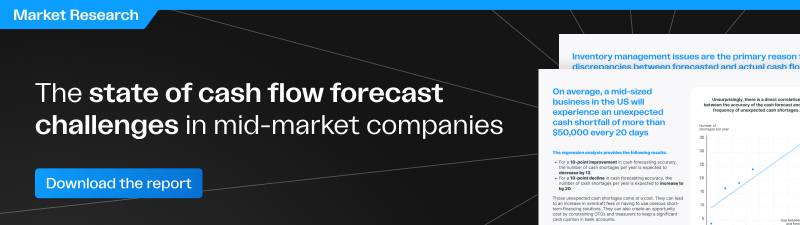
Companies with robust planning systems can identify potential cash shortfalls well in advance, giving them time to secure additional funding or adjust operations before problems become critical. According to Agicap’s own research among mid-market companies, 43% of US mid-market companies rely on unreliable cash flow forecasts and experience an unexpected cash shortfall of more than $50,000 every 20 days. On average, these forecasting challenges cost companies $465,000 per year—highlighting the high price of poor planning.
Strengthens financial credibility with stakeholders
When finance leaders lack full confidence in their cash visibility, as many do, reliable cash planning becomes a trust-building asset. It underpins more informed conversations with banks, investors, and executive leadership, enabling smarter capital deployment.
The 3-Step Method to Create a Reliable Cash Flow Plan
Step 1 – Analyze Historical Cash Movements with a Month by Month Cash Flow Statement and Table
The first step in building a reliable cash flow plan is understanding how cash has moved through your business over time. Start by reviewing the past 6 to 12 months of bank transactions and categorizing every inflow and outflow. This forms the baseline for your forward-looking projections and helps identify patterns you can use to improve forecast accuracy and construct an accurate month by month cash flow statement.
Optimize income and expenses into consistent categories, for example: customer receipts, salary payments, inventory purchases, tax refunds, and software subscriptions. Then total the amounts by category for each month and input them into a detailed cash flow table (use Excel, a planning tool, or cash management software). This process allows you to monitor your accounts payable alongside every incoming receivable to keep your operational cash in balance.
You can then calculate your metrics correctly to visualize your cash position month by month and understand how operational activity has influenced your liquidity over time:


This allows financial managers to systematically analyze key aspects of liquidity control:
- •
Categorize all inflows: Sales revenue, financial investments, grants, tax refunds, licensing income, and so on.
- •
Categorize all outflows: Payroll, inventory, marketing, general expenses, software subscriptions, capital expenditures, etc.
- •
Identify seasonal patterns: When do your customers typically pay? Are there seasonal dips or peaks in sales?
- •
Calculate payment cycles: What's your average days sales outstanding (DSO)? How long do you typically take to pay suppliers - your days payable outstanding (DPO)? What's your overall Cash Conversion Cycle (CCC)?
Example Cash Inflows and Outflows Matrix
Understanding characteristics such as urgency and predictability can help prioritize which cash flows to focus on for maximum planning impact.
Cash inflows | Frequency | Predictability | Timing control |
Customer Payments | Variable | Medium | Low |
Subscription Revenue | Regular | High | Medium |
Investment Income | Regular | High | High |
Loan Proceeds | Occasional | High | High |
Asset Sales | Occasional | Medium | High |
Cash outflows | Frequency | Predictability | Timing control |
Payroll | Regular | High | Low |
Supplier Payments | Variable | Medium | Medium |
Rent and Utilities | Regular | High | Low |
Loan Repayments | Regular | High | Low |
Discover more about cash outflow best practices
Step 2 – Build a Forward-Looking Model, Forecasting Cash Flow, and Managing Cash Flow Scenarios
Now you can start to transform insights from your past performance into a forward-facing strategy. Arguably the cornerstone of any reliable cash flow plan and corporate cash flow forecasting model.
Create driver-based forecasts
Rather than extrapolating last quarter’s figures, build your cash flow forecast template around the underlying drivers that influence your working capital. These may include sales cycles, invoice terms, seasonal demand, and customer payment behavior. A driver-based cash flow projection model enables more accurate, actionable forecasting and supports better business decision-making.
Develop multiple scenarios
Construct best-case, base-case, and worst-case cash forecasts to understand how different outcomes could affect your cash position. With 60% of CFOs now prioritizing long-term strategic planning, as highlighted by a recent McKinsey survey ("Toward the Long Term: CFO Perspectives on the Future of Finance"), incorporating corporate cash flow scenarios into your cash flow process has become essential to survive changing market conditions. After all, it helps businesses assess risk exposure, test contingencies, and maintain control under uncertainty.
Use rolling cash forecasts
Many leading finance teams now adopt a 13-week rolling cash flow forecast model that is updated weekly or biweekly to establish a reliable cash flow timeline. The benefits of this approach include improved forecast accuracy and adaptability, thereby enabling faster reactions to unexpected changes. In addition, businesses that use software with real-time cash visibility and automated updates can maintain forecasting accuracy without relying solely on spreadsheets or manual adjustments.
Step 3 – Monitor, Adjust, Iterate
A cash flow plan is a living strategy that should evolve in tandem with your business activity. Once you’ve built your forward-looking model, the key is to monitor performance against that model, adjust it regularly, and keep stakeholders aligned by updating your weekly cash flow projection.
Use rolling forecasts to compare actuals versus plan
Set a routine to review actual cash inflows and outflows against your forecast, ideally weekly or biweekly. These variance checks and cash flow forecast analyses help you spot unexpected shifts early and understand the root cause. Did a major customer pay late? Did a planned expense get deferred? By pinpointing these discrepancies, you can refine your cash flow forecasting and improve decision-making over time.
Update forecasts frequently
Businesses operating in volatile or fast-moving environments benefit most from rolling forecasts, updated in real-time or at least every 7–14 days. Tools that pull live bank data automatically reduce the burden to collect data and ensure you're working with the latest numbers rather than last month's guesses.
Communicate and collaborate
Cash flow management is now of interest to many beyond the CFO. Share forecast updates with senior leadership, finance teams, and, where appropriate, your board or external stakeholders. This builds trust and ensures you’re ready to act quickly if cash constraints happen, or equally if investment opportunities arise.
If you want to increase your company's cash performance, read our article on best practice cash flow management .
Real-World Example: Sample Cash Flow Plan in Practice
Let’s imagine this is the cash flow forecast from a mid-market technology services company, which forms the foundation of their quarterly cash flow plan:
Cash Flow Forecast - Q1
Category | January | February | March |
Starting Cash Balance | $47,300 | $64,850 | $68,420 |
Cash Inflows |
|
|
|
Sales Revenue | $83,650 | $89,240 | $96,180 |
Consulting Fees | $4,200 | $1,800 | $2,650 |
Interest & Other | $180 | $120 | $220 |
Total Inflows | $88,030 | $91,160 | $99,050 |
Cash Outflows |
|
|
|
Payroll & Benefits | $34,680 | $34,680 | $35,240 |
Suppliers & Contractors | $23,750 | $27,320 | $31,180 |
Office & Operations | $7,840 | $8,290 | $8,750 |
Marketing & Sales | $4,210 | $6,500 | $7,880 |
Total Outflows | $70,480 | $76,790 | $83,050 |
Net Cash Flow | $17,550 | $14,370 | $16,000 |
Ending Cash Balance | $64,850 | $79,220 | $84,420 |
Strategic Takeaways from the Plan
1. Action taken based on forecast insights
The forecast showed steadily increasing net cash flow across the quarter. Based on this upward trend, the finance team chose to increase marketing investment in February and March to take advantage of growth opportunities, while still keeping their minimum cash buffer of $35,000 intact.
2. Built-in contingency plan
To prepare for downside scenarios, the team modeled a 20% drop in March sales. In that case, they had a pre-approved plan to defer $8,000 of non-essential marketing spend. This would keep the cash position above the required minimum, preserving flexibility without risking liquidity.
This demonstrates how a cash flow plan uses the forecast data to drive strategic decisions and prepare contingencies.
Common Pitfalls in Cash Flow Planning (And How to Avoid Them)
Manual spreadsheets leading to errors or delays
Studies indicate that approximately 90% of spreadsheets contain at least one significant mistake. According to Agicap's Mid-Market Survey, 26% of companies still consolidate their cash positions manually using Excel spreadsheets, an error-prone and time-consuming process.
Lack of real-time data means missed cash risks or opportunities
Traditional month-end reporting can leave finance teams flying blind for weeks at a time. Manual processes such as paper-based reporting, manual data entry, and spreadsheet-based analysis are slow with a higher risk of errors and inaccuracies.
Fragmented cash visibility across accounts or business units
Fragmented cash visibility across accounts or business units can significantly undermine forecasting accuracy, dropping by as much as 19% as the number of bank accounts, legal entities, and currencies increases. Many finance leaders still rely on unreliable cash flow forecasts, which can result in missed investment opportunities and higher bank overdraft costs.
Static plans that don't adapt to change
In volatile markets, yesterday's assumptions may be irrelevant tomorrow. Companies need dynamic models that adjust to changing conditions.
Forecast Accuracy Comparison: Manual vs. Automated Methods
Method | Typical Accuracy | Time Investment | Typical Error Rate | Scenario Capability |
Excel Spreadsheets | 60-70% | 15-20 hours/month | 88% contain errors | Limited |
Basic Software | 75-85% | 8-12 hours/month | Significantly reduced | Moderate |
Advanced Platforms | 85-95% | 2-4 hours/month | Minimal | Extensive |
Source: EY Cash Forecasting Study, Finance Alliance Research
Cash Flow Planning with Agicap: Smarter, Faster, More Accurate
Agicap is built to help finance teams turn their cash flow plans into true operational tools. Instead of static spreadsheets, you get real-time visibility, flexible forecasting, and simple ways to adjust your plan as conditions change. It’s designed to support the day-to-day realities of cash management, while giving you the confidence to make faster, more informed decisions.
Four Key Features for Finance Teams
1. Live bank integrations for real-time cash visibility
Automatically connect to all business accounts for up-to-the-minute cash positions across multiple entities and currencies.
2. Scenario planning to model uncertainties
Test different 'what-if' scenarios to understand potential impacts of business decisions before committing resources.
3. Automated categorization of transactions
Eliminate manual data entry and reduce categorization errors with intelligent transaction recognition.
4. Dashboards with KPIs for tracking performance
Monitor key cash flow metrics and variances against plan in real-time, with alerts for potential issues.
Tangible Benefits
Agicap is all about tackling real-world finance challenges head on. Benefits of using our software include:
Time saved vs. spreadsheets
What traditionally takes weeks to organize, update, verify, and analyze with Excel, modern cash flow management software like Agicap can accomplish in minutes. Our customers report saving 15-20 hours per month on cash flow processes alone!
Better liquidity management and fewer surprises
With accurate forecasting, companies can optimize their cash deployment and avoid costly emergency borrowing. Agicap customers typically reduce overdraft fees by up to 91% compared to companies using manual forecasting methods.
Improved team collaboration and reporting accuracy
Centralized platforms like ours eliminate version control issues and ensure all stakeholders work from the same accurate data.
How to Choose the Right Tool for Cash Flow Planning
What to Look For
While the functionalities needed by each company might change slightly, typical aspects to watch out for include:
- •
Quick implementation: Look for solutions that integrate easily with your existing accounting systems without lengthy IT projects. Think weeks not months, or even years.
- •
ERP/bank integration: Top solutions can improve forecast accuracy by 30-50% compared to spreadsheet-based forecasting through real-time data connections.
- •
Multi-entity and multi-user features: As your business grows, you need tools that scale with complexity without sacrificing usability. This is important to check with your vendor.
- •
Reliable support and onboarding: Choose providers with proven track records of successful implementations and ongoing support.
Why Finance Teams Choose Agicap
Built for strategic yet simple financial planning. Agicap bridges the gap between sophisticated forecasting capabilities and user-friendly interfaces that don't require extensive training. That's why it is used and trusted by 8,000+ CFOs and controllers. A proven solution for modern finance leaders across industries, geographies, and company sizes.
And it's designed for ease of use, even for non-technical teams. Forget complex formulas or advanced Excel skills. Agicap's simple user interface means you can focus on analysis, not data manipulation.
Ready to Build a Cash Flow Plan That Keeps Pace with Your Business?
Join the thousands of finance professionals who use Agicap every day to:
✓ Eliminate spreadsheet errors with automated data integration
✓ Automate 95% of the creation and export of journal entries generated from bank transactions.
✓ Achieve 90%+ forecast accuracy with real-time visibility
✓ Reducing cash flow management from 32 hours a week to just 2 hours

Frequently Asked Questions (FAQs) About Sash Flow Planning
How do you do a cash flow projection?

To create a cash flow projection, start by listing all expected cash inflows (e.g., sales, loan proceeds, investment income) and outflows (e.g., payroll, rent, supplier payments) for a defined time period, typically weekly or monthly. Use historical data and business drivers (like sales cycles or payment terms) to estimate future transactions. Then calculate the net cash flow for each period and roll it forward to see your anticipated cash position.
What is an example of cash flow?
An example of cash flow is when a customer pays an invoice and $5,000 enters your business account; in this case, it is a cash inflow. If you then pay $3,000 in salaries, that’s a cash outflow. Subtracting the outflows from the inflows, your net cash flow for the period would be $2,000.
What is a cash flow plan?
A cash flow plan is a forward-looking financial roadmap that forecasts when, where, and how much cash will flow into and out of your business. Unlike a static cash flow statement or a simple projection, a cash flow planning template includes expected cash movements plus scenario analysis, decision triggers, and actions to take if certain outcomes occur.
It’s a tool for both short-term liquidity control and long-term strategic planning.
What is cash flow?
Cash flow refers to the movement of money into and out of a business over a given period. Positive cash flow means you have more money coming in than going out, while negative cash flow indicates the opposite. It's different from profit, which is based on accounting rules and may include non-cash items like depreciation.
What is a cash flow forecast?
A cash flow forecast is a financial estimate of future cash inflows and outflows over a set time horizon (often 13 weeks or 12 months). It helps businesses plan ahead, anticipate funding gaps, see what they can invest, and make informed operational decisions. Cash flow forecasts are typically updated regularly (even in real-time using tech) and used to manage day-to-day liquidity.
How do you create a cash flow?
To create a cash flow forecast, follow these steps:

Start with your opening cash balance.
Project all expected cash inflows (e.g. sales, interest, grants).
List all anticipated cash outflows (e.g. payroll, rent, supplier costs).
Subtract total outflows from total inflows to get net cash flow.
Add net cash flow to your opening balance to calculate your closing cash position.
Repeat this for each period, adjusting the forecast regularly based on actual performance.
How do you calculate cash flow?
Basic net cash flow is calculated as follows: Net Cash Flow = Total Inflows – Total Outflows
For operating cash flow, you typically start with net income, then adjust for non-cash expenses and changes in working capital (like inventory or receivables). For cash planning, the focus is on actual cash movement, not accrual-based figures.
What is a cash flow statement?
A cash flow statement is a historical financial report that shows how cash has moved through a business over a specific period. It’s typically divided into three sections:
Operating activities
Investing activities
Financing activities.
This statement is used for compliance, audit, and reporting purposes, but unlike a cash flow forecast, it doesn't predict future cash movements.
Find out more about how to analyse your cash flow statement in our quick guide.


